
Archive for the 'movie reviews' category
Quantum of Solace (2008)
March 27, 2009 3:23 am
“Impress me”, M in Quantum of Solace
I should really have reviewed QoS back in October when it opened, but due to a combination of the usual month-long Bondmania (where every TV presenter and z-list celebrity declares their undying passion for Bond but probably couldn’t name one actor who’s played Blofeld, let alone all seven eight [props to harry Webshiter, see below]) and a rotten cold, I felt I couldn’t give the film a fair crack.
After two subsequent viewings, and a period of grace, the time has come. And I have to say it’s not great. And what follows may contain spoilers (if it’s possible to spoil the story of a Bond movie).
As someone who has long championed the Fleming-esque route to Bond movies over the space lasers and world domination world that tarred Roger Moore’s tenure (go and watch them again, they are not all like that), Casino Royale was the film I thought I would never see: a perfect mix of well-directed, exciting action, a decent story, good acting and a film that didn’t rely on outdated cliches.
QoS was suppossed to continue this trend. The hiring of Marc Forster, a man not normally regarded for his high-octane action films, to direct seemed to be a step in the right direction. Oscar-winning screenwriter (as we are CONSTANTLY reminded) Paul Haggis was retained from Casino Royale, along with Bond alumni Robert Wade and Neal Purvis, the men who are were rather cruelly blamed for Die Another Day‘s excesses, and then recieved no acclaim for Casino Royale.
The film begins just minutes after the end of Casino Royale, with Bond having captured the mysterious Mr White. he is being tailed, presumably, by White’s men in a hair-raising car chase opening, before Bond arrives at his rendezvous with M in Sienna. A traitor is revealed, White escapes, and so begins a hunt for the ‘organisation’ that White works for (“The first thing you need to understand about us is we have people everywhere”, White chillingly informs M), whilst Bond still tries to come to terms with Vesper’s betrayal and death at the end of Casino Royale.
Oh, yes. This is a proper sequel. If you haven’t seen Casino Royale, you will have no idea what the hell is going on for most of the film’s running time. But you won’t be alone.
The first of QoS failings is it’s length. Bond films have been criticised in the past for having too much padding, and regular run over two hours. Casino Royale was the longest ever, clocking in at almost 2 and a half hours. QoS by contrast is 45 minutes shorter, and the shortest film in the entire series. This means the film moves at such a relentless speed, it doesn’t have time to breath. This is fine for a high-concept film like …erm… Speed, where the plot is simple, and the film is all about the next action set piece. But QoS has an incredibly complicated plot, and factor in the baggage from Casino Royale, and you’ve got a lot of story to tell, mixed in with the action scenes (of which there is probably too much after the leaness of Casino Royale), and the whole thing feels like an over inflated balloon waiting to burst.
As a consequence important plot details get lost in the mix. Expositional dialogue is often played out over other scenes, competeing for your attention. In one particularly annoying scene the viewer is asked to read two seperate subtitled conversations at the same time while having no idea which on is the important one (one is completely superfluous, and is merely ‘ominous’, a nice touch that would have worked better in islolation).
As with Casino Royale, the casting is brilliant. Mathieu Amalric is a superbly odious villain, perhaps due to his terrifying resemblance to Roman Polanski. He’s a small chap, always flanked by larger bodyguards, but he fight’s dirty, and is a worthy adversary for Bond. Olga Kurylenkois a fine replacement for Eva Green as chief Bond girl. As usual, there’s the standard guff about she’s ‘not a dollybird, she’s Bond’s equal’, and to be fair, she is certainly a lot tougher than usual. She’s waging her own vendetta, gunning for the corrupt general (and secondary villain) who murdered her family when she was a child.
It’s also great to see Giancarlo Gianni and Jeffrey Wright reprising their Casino Royale roles, but sadly both are criminally neglected again. And of course Judi Dench steals every scene she’s in, and this time she is particularly grumpy.
As always though, there is one weak link, and in this case it’s Gemma Arterton. She claims to have based her portrayal of ‘Strawberry’ Fields on the classic Bond girls Honor Blackman and Diana Rigg. But to me it seems she based it more on Britt Ekland and Talisa Soto. She doesn’t have a great deal to do, just turn up wearing a Graham greene-era spy raincoat and awful suede boots (and, it’s implied, nothing else), sleep with Bond, go to a party and die. That’s all she’s there for. She doesn’t advance the plot or assist Bond in anyway. And she can’t even do this well. She has all the charisma of a wet rag, and less acting ability. It’s interesting that despite how little dialogue she has, most of it is obviously, and painfully, re-dubbed afterwards.
But what really grates, what really annoys, is the fact that this just doesn’t feel like a Bond movie. I know, it’s a statement as old as the hills (I remember my dad saying it when he saw The Living Daylights years ago), and it’s a bold claim to make because everyone has their own idea of what exactly a Bond film is.
When I say it doesn’t feel like a Bond movie, I don’t mean little things like the lack of a gunbarrel at the start, the loss of Q and Moneypenny, or even the absence of the Bond theme (again). These are really inconsequential when you consider the fact that you could substitute Bond for a generic secret agent, or any other man-on-a-mission type character, and it wouldn’t alter the film one iota.
The presence of so many Bourne crew members over the traditional ‘Bond family’ demonstrates a decision to move Bond on, which is fine. But into what? Bond movies have always been distinctive; they’ve always stood out from the crowd. How else to explain why the films kept on going when all those late 60s interlopers died out? Quite simply, Bond offered something that no-one else was doing, and sadly, that is no longer the case.
The producers (a finer pair of individuals than you could wish to find, alright, I fancy Barbara Broccoli…) may claim that the ‘traditional’ Bond movies wouldn’t work in our ‘troubled’ times, whilst the popular films at the box office are comic-book adaptations who do a fine job of making the most ridiculous scenarios believable. (Did any of the millions who flocked to The Dark Knight complain it wasn’t realistic?). Bond was never rooted in reality, that was part of the charm. By dragging him kicking and screaming into the 21st century they have stayed true to Fleming, but neglected their filmic roots.
What a don’t understand, is Casino Royale did an almost perfect job of straddling both stools, so it seems to me the fault lies at the feet of the director, and the unfamiliar crew. Bond fans would note that beyond the writers and producers, the only prominent Bond family members are SFX man Chris Corbould, composer David Arnold (doing his best Bond work since Tomorrow Never Dies) and casting director Debbie McWilliams, and all do sterling work.
Beyond that everything else is servicable, professional, but strangely generic. Forster is clearly no action director, and in combination with some of the worst editing in the series, most of the stunt scenes (mostly in-camera for a change) are rendered unintelligable. For instance, early on Bond chases an assasin across some Italian rooftops (in a neat reprise of a lost scene from On Her Majesty’s Secret Service). It’s easily the most exciting sequence in the movie. At one point Bond slips on some roof tiles and has to make a leap across to the next building. In the making-of documentaries, it clearly shows Daniel Craig performing this himself (on a wire, but still…), but in the film the scene is cut to shreds so you can’t appreciate the full magnitude of it. There’s at least four or five cameras, and everything is so shot so close, you get no sense of how high he is or how far he’s lept.
There’s a boat chase too, of which most was done for real, but for some reason the best shots again, only appear in the documentaries. The moment that Bond pierces one of the pursuers motorised dinghies replaces a spectacular shot of the boat somersaulting over Bond’s boat, with a ghastly shot that looks like poor CGI. It’s infuriating.
QoS isn’t a bad film. Not by a long shot. It’s a perfectly adequate action film. But that’s all. The proposed ‘character arcs’ are rather lumpen affairs realised through the use of deep and meaningful (and ultimately complete toss) dialogue, while you’re waiting for someone to explain what the bloody hell is going on.
My wish for Bond 23 would be for Wilson and Brocolli to beg borrow and steal to get Martin Campbell back in the director’s chair, give Bond a meaty story (it appears the QUANTUM organisation will continue to be the villains) and another worthy adversary. But give the film the room to breathe. Bond fans are not the same impatient teens who want their films beamed directly into their brains because they can’t deal with a shot that lasts longer than two seconds. You’ve proved a serious, mature Bond film can work, then gone and created a happy-meal version of it.
Sorry, but M will not be impressed with that.
Burn After Reading (2008)
March 9, 2009 5:55 am

 It’s tough following a big Oscar win. Cuba Gooding Jr decided that the best way was to appear in a succession of appalling ‘comedies’; Halle Bery and Nicolas Cage went down the ‘awful action movie’ route; and most directors normally disappear up their own arse making impenetrable, pretentious drivel, in an attempt to replicate the success of their ‘personal’ movie.
The Cohen Brothers, on the other hand, just carried on doing what they do best. That is, making whatever the fuck they want, normally side-stepping any possible expectations that the critics and audience could possibly have about what they’ll do next. As a result, many people were somehwat perturbed by Burn After Reading, a film that has so divided critical and public tastes that it just HAS to be watched.
This isn’t new for the Cohens. After the huge success of Fargo, they followed it with The Big Lebowski, to the utter bemusement of the paying public. Critics dismissed it as silly and self-indulgent, and the public stayed away, the film only finally finding its (now huge) cult audience on video.
I feel the same will happen to Burn After Reading, which critics dismissed as silly and self-indulgent, and the public stayed away… oh… deja vu…
The thing is, there is no way to describe what a Cohen Brothers film is. So for critics to say this isn’t worthy of them is a little ridiculous, because NOTHING is not worthy of them. They’ve done just about everything except sci-fi.
John Malkovich (in shouty crackers mode) is a CIA analyst who is unceremaoniously sacked for his alcoholism. This sets in motion a truly bizarre series events involving married serial-womaniser George Clooney, Malkovich’s wife, Tilda Swinton, and a pair of none-too-bright gym workers, played to perfection by Frances McDormand and Brad Pitt (complete with Johnny Suede style hair).
The first 20 minutes or so are almost impenetrable, and could result in the casual viewer giving up before the fun starts, but once the Macguffin of a computer disk, supposedly containing “CIA shit” is introduced, things start motoring at a terrific pace, and everything begins to fall into place.
One thing most of the film’s detractors commented on is the ‘gang-show’ mentality of the whole thing. Just about every cast member has previous with the Cohen’s, and those that haven’t (specifically Malkovich and Pitt) had their parts written specifically for them. Swinton was brought in at Clooney’s request, after appearing with her in Michael Clayton.
I don’t understand the criticism though. Many people cite the Ocean’s films as another example of people seeming to have more fun than the audience. I think this is preposterous. How many times do crtics chastise a film because the leads have no chemistry? Surely a film where everyone is comfortable acting with each is a bonus, not a hinderance?
Well, that’s certainly the case here. While McDormand and Swinton are operating pretty much on effortless auto-pilot (but are excellent), and Clooney does his kooky jerk turn, Pitt and Malkovich are simply awesome. Pitt has honed and refined his Twelve Monkeys quirkyness into a genuinely stupid character. The scene where he tries to blackmail Malkovich and gets a bloody nose for his trouble is one of the funniest things I’ve seen in the past year.
Another Cohen regular, composer Carter Burwell, delivers a superb thriller score which is often at odds with the on-screen action, creating a terrificly disorientating mood at times. The look of the film is superb as well, with a wonderfully grey, cold look (all concrete and chrome) which also produces unease. The look of Russian Embassy, reminded me of both Eraserhead and Brazil.
What finally caps the film as a winner, for me, is a glorious final scene which not only explains, but possibly negates everything we’ve watched. It could also be the final reason why so many people DIDN’T like the film. To say anymore would be cruel, but I firmly believe that the chances of you enjoying Burn After Reading are strongly linked to how much you like the final scene.
It’s not an easy film to love. The difficult introduction will test many people’s patience, but those who stick with it should find themselves swept away on an increasingly ridiculous, but hilarious, ride that never goes the way you think it will.
Halloween (2007)… spoilers abound
February 23, 2009 6:49 am
Doctor Wynn: … For God’s sake. He can’t even drive a car!
Doctor Loomis: Well he was doing very well LAST NIGHT!
With that exchange of dialogue, John Carpenter probably best explains his motives with the superlative Halloween. Logic is so far out the window that it’s on the next train to Glasgow. It doesn’t matter how Michael Myers, locked up in an institution for 15 years, knows how to drive a car; it doesn’t matter why he’s killing people; it doesn’t matter why he fixates upon young Laurie Strode. It’s almost as if the attitude is “If you’re asking too many questions, you probably shouldn’t be watching these kind of movies”.
Unfortunately these brazen tactics are completely ignored by Rob Zombie’s remake (from hereonin my reviews will ONLY refer to films like these as ‘remakes’… terms such as reboot, re-imagining, revision, and herefore banned).
In my remakes rant post last week I, rather foolishly suggested that Halloween 2007 had some redeeming features without actually having seen it. This is not a mistake I shall repeat, as what follows is going to make me look a little foolish.
Now, I love Halloween. Ever since I saw it as an impressionable 11 year old, right through film-studies-wank adolesence, right up to genre-hugging adulthood, it has always retained it’s place in my affections as the Citizen Kane of horror films. It’s just so well constructed and executed (pun intended) that the only thing that fades its gloss slightly is the fact that it led, indirectly, to a slew of sewage for which it is always blamed.
With this in mind, I did try (REALLY try) to be objective about Halloween 2007, and, to be fair, it’s not a complete and utter abortion of a movie. Just mostly.
I like Rob Zombie. I was a passing fan of his music for a while, and whilst his films leave me cold, I can appreciate his craft. He’s an extremely hands-on director which means everything in his films meet his desired vision. All his films so far have this wonderfully scuzzy 70s look to them, not seen since the days of Last House on the Left (remake on the way… joy!)and I Spit on Your Grave. I think it would have been great to have let him loose on Grindhouse with more than just a spoof trailer (Death Proof would certainly have been more entertaining with him behind the camera).
Having said that though, I find his films an ordeal. Exploitation horror, no matter how grim, should still be watchable, and I find that isn’t the case with his films, especially the Devil’s Rejects, which assaults the viewer with one uncomfortable scenario after another. Maybe that’s the point and I’m missing it. But it’s not my cup of tea.
So, it’s a strange combination to have a sleek, professional machine like Halloween turned over to a man who prefers his movies dipped in mud, bleached in the sun, and run through a combine harvester before they hit a screen near you.
It’s taken me 18 months to get round to watching Halloween 2007. Two of my objections were thusly: we get a Michael Myers backstory, and it’s revealed Laurie is Michael’s sister. Both are bad ideas for different reasons.
Firstly, Michael doesn’t NEED a backstory, let alone one that takes up half the running time of a film about a man killing people on Halloween. Michael is just evil. Isn’t that enough? And then having taken this route they then decide NOT to tell us why he stops talking to people. he’s quite a chatty young man when he first murders his family (save mum and baby sister) and a school bully. After a year in an asylum he just shuts up and no-one can get a word from him.
He then kills a nurse for no reason. Then nothing for fifteen years.
I really struggled to work out what was going on here. If you go to all the trouble of inventing an entirely new backstory for a character, why then introduce such random events seemingly only to tie him into the futrue incarnation of said character that the public is familiar with? It’s a bit like writing the Star Wars prequels with Ben Kenobi as a dwarf and Yoda as a giant, then half way through Revenge of the Sith they suddenly revert to their familiar appearance.
After this seemingly endless first act, Michael finally arrives home and we’re into more traditional remake territory: dialogue is lifted word-for-word, scenes are replicated shot-for-shot, and, perhaps most annoying of all, characters are cast (and dressed) to look exactly like their 1978 counterparts (namely Tommy Doyle, and the ill-fated Bob). This appears to be done simply to throw the audience off course for some cheap scares, which is a dirty and nasty trick played so often when the last one occurs you wish Michael would turn around and start hunting the man behind the camera rather than those in front of it.
So some scenes are retained, others are re-jigged, and other new ones are introduced. If you’ve never seen Halloween (shame on you) the scenes repeated from the original are the ones with no blood whatsoever. If there’s blood (and there’s plenty of it) it’s a new scene.
So what’s Michael up to? Well, he’s looking for his baby sister he hasn’t seen since she was in nappies. “What, what, what? That wasn’t in Halloween!” I hear you cry before the fanboy’s jump on me and tell me that “It was introduced in the sequel and is therefore valid”. Well, guess what? It’s fucking not, cos John Carpenter says so!
Yes, Carpenter wrote the script for H2, where it was revealed that Laurie had been adopted by another family after her (and Michael’s) parents died. But Carpenter also regretted doing it. So there.
This ‘twist’ results in a very tiresome climax that goes on for about fifteen minutes longer than it needs to, and an ending closer in spirit to Texas Chainsaw than Halloween. In fact watching this I couldn’t help but think how much better TCM 2003 would have been if Zombie had directed it.
I said it’s not all bad. The opening half is actually very engaging, mainly because it’s not aping anything we know. It’s mostly all new. Forget the film is called Halloween and the opening half hour (up until the first murders, yes, it takes that long) is very good. Another advantage for freaks like me, is almost every supporting character is played by someone who’s made their name in horror films. We’re not talking horror legends, more exploitation legends like Sybil Danning, Ken Foree and Mickey Dolenz (!) .
The stunt casting goes a little too far, casting 29 year old Danielle Harris and one of Laurie’s pals. Harris played Michael’s neice in the original cycle’s parts 4 and 5.
Malcolm McDowell is, however, excellent, as as fine a replacement for Donald Pleasance as we could have hoped for, mainly because, for once, he plays down.
It was always going to take something special to top Carpenter’s original vision of ‘movie as a ghost train’, simply designed to go”Boo!”.
Zombie’s movie only says “Boo!” once, and it’s one of the best moments. It prefers to stand in the open shaking a knife at you and asking “Well, are you scared? Come on, I haven’t got all day!”
I’m all for Zombie making his own vision, that’s fine, but it’s so completely incompatible with Carpenter’s it’s like a child trying to build a dolls house using a combination of Lego and Sticklebricks: they just don’t fit together. I would have been willing to accept Zombie’s vision if that’s what we’d been given. Instead we’re handed two movies welded together, with far too much post-modern sprinkles to sweeten it up for the fanboys.
Well, this fanboy found the whole thing a little nauseating. And as with most of the current rash of remakes (in fact those stretching back over the past decade) it just makes me want to go back and watch the original. In fact, I’d rather watch any of the sequels over this. OK, apart from Ressurection. And Curse (Pleasance’s last film, fact fans!). No, actually this is worse than Curse …
 Oh, and what do you know… H2 is heading our way this year. For fuck sake!
Sleepaway Camp (1983)
February 6, 2009 6:18 am
 Wayhay! There’s just a week to go until the most pointless horror remake since… er… the last one, so in honour of Friday the 13th‘s place in horror movie lore, it’s time to assess one of the many films which appeared in its blood-soaked wake.
Sleepaway Camp was not the first film to attempt to cash in Friday the 13th‘s success. That particular award, most probably, goes to the Weinstein’s The Burning. A great film for gore fans thanks to Tom Savini, but also overall utterly dreadful, despite early appearances by Holly Hunter, Fisher Stevens and Jason Alexander (and, no, he didn’t have much hair then either).
And Sleepaway Camp appeared in 1983, around the same time that Friday the 13th was entering it’s 3rd film in the series. Yet, somehow, it managed to not only be successful, but also retain a rabid cult support that lasts to this day, including TWO competing ‘offical’ fan clubs.
In fairness, whilst Sleepaway Camp incorporates many familiar slasher film conventions, it also rejects just as many. We may get POV stalking shots, but we don’t get blood splattered all over the place. Only one murder is particularly gory. The others are very cleverly designed and directed to leave the worst excesses to your imagination, which is, of course, much worse.
Following a tragic boating accident in which her brother and father are killed, Angela is sent to live with her eccetric Aunt Martha. In the first of many bizarre scenes the introduction to Martha not only makes us think she’s a washed up soap actress, due to her exaggeratted acting style (she’s actually a doctor, suppossedly), but we also see she has the largest hands in the world.
Anyhoo, Angela and her cousin Ricky are packed off to summer camp for skinny dipping, volleyball and peadophile cooks. (I’m not making this up, I swear… they actually make a joke about the fact one of the cooks is a nonce! Ah, happy days.)
Angela is a tad shy, and upsets a lot of people by refusing to speak, or eat, until she takes a shine to Ricky’s friend Paul, a dead ringer for Doogie Howser.
Slowly eveyone who upsets Angela is put to the sword, or rather the boiling pan of water, the sea snakes and, of course, that hunting knife confiscated by the camp counselors, before we get to the end (I won’t give away the ending but will get back to it in a bit).
This is all played out against the now very familiar backdrop of hormonal teenagers, but everything here seems slightly off, compared to Friday the 13th or The Burning.
On top of the lack of obvious gore, the other classic element of the slasher film, gratuitous nudity, is also missing. In the one scene where nudity, gratuitous or otherwise, would normally have been included (the inevitable shower scene), the camera stays resolutely just above the nipples. Even the skinny dipping scene only results in some spotty looking men’s bums.
This may be a result of the fact that unlike its predecessors, Sleepaway Camp, focusses on the KIDS, rather than the camp’s almost-adult staff. Sometimes, it’s difficult to tell which is which, such as the dickhead jock who hits Angela with a waterbomb. he was a guest apparently, but looks at least 20 years old.
What it does have is some of the finest kids swearing ever committed to film. In the waterbomb scene alone, Ricky manages at least two each of ‘cocksucker’, ‘motherfucker’ as well as various ‘pricks’ and ‘fucks’ throughout the duration. And he’s suppossed to be about 13. Good work, fella!
But does a lack of gore and T&A make for a bad movie? Not when the fashions on display are probably the most terrifying thing in the movie. Now, I may have only been a kid in 1983, but I certainly don’t remember wearing shorts as tight as the ones on display here. These things look like they could cause serious damage to the male anatomy. Not to mention the camp chief’s golf trousers, or his knee-high black socks with shorts and sandals combo.
So, seemingly, lacking in all the ingredients neccessary for a hit, how has Sleepaway Camp retained such affection? Two words… The Ending.
Watching it for the first time, and knowing how it ends, I could easily spot the hints dropped throughout. But if you are a Sleepaway virgin, it may genuinely shock you. And that’s all I’m saying.
Sleepaway Camp is great fun. As with just about every slasher from the era, you know pretty much what you’re going to get from frame one, but it does have the ability to surprise you once or twice. It’s murders are positioned like clockwork throughout the running time and it’s certainly never dull.
If I had one complaint it would be the decision to shoot the last half an hour in almost total darkness (though this could be due to me still trying to find the right settings on my TV).
If you like your horror cheesy, with a pair of tight shorts, you could do far worse. Like watching the F13 remake, probably.
The Tall Guy (1989)
January 29, 2009 5:34 am
Richard Curtis is such an enigma, I swear he has an evil doppleganger who is going around trying to bismirch his good name.
How else can you explain that the same man who wrote Blackadder also created The Vicar of Dibley? Or that th eman who gave us the witty and emotional Four Weddings and a Funeral also gave us the cynical, emotionless Notting Hill?
 (And the least said about Love Actually the better, except that Lady Scaramanga has vowed never to watch it again, and she’s seen Notting Hill at least five times!)
 For me, Curtis’ masterpiece, in cinematic terms at least, is the underrated and near-enough forgotten The Tall Guy. It’s a film that remembers it’s a comedy first, then a romance; it laid down the ground rules for Brit RomComs for years to come (for better or worse) and gave the world probably the greatest sex scene ever (of which more later).
 In terms of structure, anyone who’s never seen it before will see we are in familiar territory. Jeff Goldblum is the lovable loser who just can’t find the right girl. His circle of friends include his nympho flatmate, a funny foreigner and a blind man (the disabled friend would become a Curtis fixture; here it’s simply for comedic effect rather than as a crowbar plot device in the final reel).
 Whilst recieving injections for allergies, he meets and falls in love with kooky nurse, Emma Thompson (never lovlier than she is here), and their relationship goes through the standard cinematic motions.
 Also in the mix is Goldblum’s employer. Rowan Atkinson plays the odious and ridiculously successful comedian Ron Anderson. Goldblum is Anderson’s straight man in his West End show, and he eventually gets fired after missing a show. Anderson is such a wonderful creation, mainly because, if rumours are true, his persona is not a million miles away from Atkinson’s. Only Curtis and director Mel Smith (yes, THAT Mel Smith) could have possibly persuaded him to do it.
 Following a hilarious montage of Goldblum trying out for various ‘legitimate’ theatre productions (the Berkoff is easily my favourite), he lands the plum role in a vulgar new West End musical based on the life of John Merrick, called, simply, Elephant! (exclamation mark included).
 And so on, until Goldblum and Thompson split, then get together again for a slow-mo hug in the middle of casualty.
 It all sounds dreadful, and it very nearly could have been. Watching with cynical eyes everything seems cliched up to the hilt. But it’s like watching the original Halloween now: it only seems cliched because everything that followed ripped it off so much.
 There’s so much good stuff here, it’s difficult to know where to start, so I’ll start at the end, or rather Goldblum and Thompson’s ends.
 The sex scene they share together is easily the funniest ever put on screen (funnier even than Body of Evidence) as the pair proceed to wreck Thompson’s flat in a fit of hormones. Anyone who says they don’t find the sight of a piece of toast stuck to Emma Thompson’s bum funny is either lying or dead.
 Then there’s Elephant! A musical so tasteless and vulgar you’d swear it had been running for ten years in the West End. We get glimpses of what’s in store through the various rehearsal scenes, but actually witnessing it is pure joy.
The sight of Thompson barely able to believe what she’s seeing, whilst Goldblum’s flatmate sits there lapping up every awful second of it is a wonderful piece of acting from both actresses.
 There’s also one-liners to die for (“What in the name of Judas Iscariot’s bumboy is going on?”; “I hope all your children have very small dicks! And that includes the girls!”), blink-and-you’ll-miss-em appearances by Angus Deayton, Mel Smith himself and Jason Isaacs.
 This being a romantic comedy, of course, the path of true love never runs smooth, and everything is rather too neatly wrapped up at the end, but by then you just don’t care because you’ve had such a laugh for the past 90 minutes.
And who knew that all you had to do was take this formula and change the sex of your imported American star to take over the world?
1408 (2007)
January 16, 2009 2:20 am
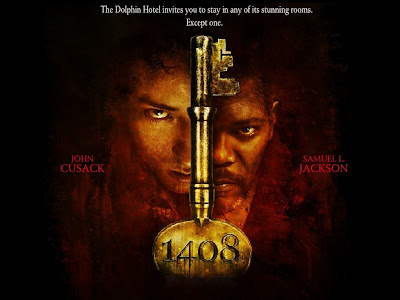
So what was the last decent Stephen King adaptation?
Most people, I imagine, would be inclined to say The Green Mile, but since I’ve no desire to see a three hour Jesus allegory with Tom Hanks discussing erectile disfunction, I’ve managed to find a spare day in which to watch it.
This was, of course, preceeded by the Greatest Film Ever Made (according to imdb users), The Shawshank Redemption. The problem with both of these is, they don’t feel like Stephen King films. It’s like saying the best Wes Craven film is Music of the Heart (Meryl Streep struggles to teach violin to inner-city Harlem kids… I’m not making this up).
Despite the occassional low-key triumph (Apt Pupil, Dolores Claiborne) there hasn’t been a great Stephen King film since 1990’s Misery. So one wonders why film studios still wet their pants over him, and even hunt out older stuff to adapt.
1408 was originally a short story in an audiobook collection first released in 1999, so why nearly ten years later it should be dredged up for a big-budget, high-profile movie is beyond me.
 Anyway… John Cusack is a writer (in a Stephen King story? You don’t say!) who is cynical, sarcastic and generally quite rude. His work consists of crappy tour guides of haunted places, of which his latest is a book on haunted hotels.
He lives a reclusive life and over the course of movie we discover ‘what made him this way’. I don’t think it’s giving anything away to say that he left his wife a year before following the death of their daughter.
One day he recives an unsigned postcard from the Dolphin Hotel in New York telling him NOT to stay in 1408. His interest peaked he decides to do the complete opposite.
The hotel manager, a superb cameo from Samuel L. Jackson (Note the word CAMEO, despite what the poster and credits may have you believe), tries his best to dissuade Cusack. he regales him with tales of suicides, accidental death and one guy who slit his own throat and then tried to sew it back with a darning needle. Oh, and the guy who drowned in his soup. Spooky…
Most people, he claims, never last longer than an hour. So there’s our ticking clock.
Undettered, Cusack checks in and within about ten minutes it’s all gone crazy-ape-shit-bonkers: a murderous woman appears, Cusack sees a reflection of an evil doppleganger, he sees his father and dead daughter, Sam Jackson appears in his minibar.
If this all sounds ridiculous, well, it is.
The first half an hour was excellent. The build up to Cusack checking in rachets up the tension superbly. Jackson’s hotel manager stays just the right side of knowing camp, and you feel he genuinely is scared of the room (it’s explained that no-one is allowed to use the room and Cusack only gets access after threatening legal action!).
The turning point comes with the first shock: yes, it’s that old staple the radio that turns itself on at an obscenely high volume… gets ’em everytime! But more terrifying than that is the fact that it’s playing The Carpenters. I shit myself. The clock radio then proceeds to inform us of how much longer Cusuack will have before he dies. So we now, literally, have a ticking clock.
Speaking of old staples we also get bleeding walls, paintings that change, mysterious voices and visions, and the classic crying baby noise (which I do find very unsettling).
Cusack is very good, basically carrying the film for 80% of it’s running time. It’s just him and the room. But there is a tendancy for his character to drift in and out of cynical mode. At one stage he is so traumatised by what he’s experiencing he tries to escape through the air vent only to be confronted by some zombie (looking oddly similar to the nazi zombies in Shock Waves). After dispatching the zombies jaw, he falls back into the room only to deliver a clunky one liner about how it’s good to be back.
You’re probably thinking, why doesn’t he just leave the room? Ah, well they’ve thought of that. You see, as Jackson explains, this room “is an evil fucking room”. When does try to leave he finds the door locked, and the key breaks off in the lock. OMG!
But it’s OK, cos he’s a modern guy, despite still using an old fashioned tape dictation machine. Hooray, he’s got a mobile phone! It only takes him half the film’s running time to finally decide to try and use it (the room’s phone, obviously, just connects to a cheery but sinister reception desk from hell), but he forgot that Jackson had already explained that “electronics don’t work so well in … 1408”. Surprising then that he manages to get his laptop to work and manages to have a slightly fuzzy video conference with his estranged wife, who seems more concerned with arguing with her clearly distressed husband, than helping him out.
The whole ‘Shining in a hotel room’ just doesn’t work. Whilst The Shining was never going make a satisfactory two hour film and be faithful to the book (personally, I love the film because it doesn’t try to make an authentic adaptation work), 1408 has barely enough going for it to cover a two hour film.
It’s a Twilight Zone episode, a Tales of the Unexpected story (particularly it’s drearily predictable and ridiculous last scene) at best. It’s impressive start is blown away in seconds and you then spend an hour being bombarded with noise and effects.
Hotel-based horror is better served recently by the low-rent (in budget, setting and cast) Vacancy.
Transformers (2007)
January 5, 2009 7:31 am
I fucking hate Michael Bay. The same way I hate Girls Aloud. Half the time they produce fast food shite that makes me want to stab my eyes (or ears) out with the bluntest instrument I can find.
Then the other half of the time they do stuff that I actually enjoy (guiltily) which makes me hate them even more.
Bay made a cracking start to his film career with two extremely, ridiculously enjoyable movies in Bad Boys and The Rock. Both showed promise, but also the guiding hand of super producer Jerry Brukheimer. In Bay it seemed Bruckheimer had found a natural successor to Tony Scott (Top Gun, Days of Thunder).
After this double whammy though, things took a downturn. Armageddon was more of the same, but showed a shift from ridiculously entertaining to just ridiculous. And then came Pearl Harbor (sic), a shameless attempt to recreate the ‘magic’ of Titanic. They succeeded only in the sense that it’s only worth watching for about twenty minutes when the SFX kick in.
So, when it turned out Mr Bay was to take the reigns of Transformers, one of the most anticipated films of all time for a certain generation of people, my heart sank lower than a certain cruise liner.
18 months on from its release, I finally caved in and in full cynic mode, I watched it. And bugger me if they didn’t do a fairly good job with it.
After a cracking opening sequence where the first Transformer is revealed (complete with the original ‘transform’ sound effect sadly lacking from the rest of the film) things settle down into a very cheesy, predictable story of Shia la Beouf playing a high school loser (yeah, right) and his attempts to buy his first car to get the girl of his dreams. (Surely, if she’s only interested in him because of his car, she’s a bit of a cow and not worth bothering with…?)
Anyhow, wouldn’t you know, the car he buys turns out to be Bumblebee, the Scrappy Doo of Cybertron, except here he’s a sexy, classic Camero, rather than a VW Beetle. This is the first of many ‘character’ changes, but on the whole they don’t really matter. Bumblebee’s new appearance is at least acknowledged, as the car next to him is a rusty old Beetle.
Many of the characters have changed since their cartoon incarnations, but for the most part it’s not a problem. I did spend the first 45 minutes thinking Bumblebee was Hotrod, and got very confused when one of the Decepticons appeared as a police car, since cars were all Autobots originally.
The transformation effects are simple stunning, with seemingly every gear and rachet seperately animated and a wonderful sense of wonder and awe when the robots true identities are revealed.
As is usual for films like this, the ‘human’ side is a bit of a let down. Le Beouf, a very likeable lad with good comic timing, is clearly on auto-pilot. Megan Fox is your typical sexy teenager, despite clearly being well into her twenties, whilst the far more attractive and talented Rachael Taylor is relegated to a supporting geek role and, along with half the cast, is completely forgotten about half an hour before the end of the film.
Then there’s the two heavyweight names in the cast: Jon Voight and John Tuturro. Voight is now an old hand at playing, well, the old hand in action adventures. Here he turns up as the defence secretary, recruiting a bunch of young trendy IT geek types to work out what’s going on… just like he did in Enemy of the State.
Tuturro is an odd one though. Clearly in it for the money, he turns up half way through as an FBI agent, clearly taking his cue from Jeffrey Coombs in The Frighteners. As if playing the paedophile, Jesus, in The Big Lebowski wasn’t an indignity enough, here he gets reduced to his underpants for no apparent reason.
There’s also a Michael Biehn-a-like soldier just back from the Middle East (and witness to the first Decepticon attack), and eventually, as usual, our rag-tag gang of characters find themselves pulled together, in this case in a secret bunker in the Hoover Dam, where the mighty Megatron has been kept in cold storage since he crash landed to Earth 100 years or so previously, searching for some cube thingy which has the ability to create new Transformers (or something… but for some unexplained reason the ones that we see it create are all evil).
After some further contrivances it’s decided the best thing to do is NOT to take the cube to the nearby Nevada desert, but a much better idea to take it into ‘The City’ where a balls to the wall CGI-fest finale can take place. And here’s where everything starts to fall apart.
One of the problems with the film is that when the Transformers are in robot form it’s nigh on impossible to tell them apart. This makes the climax a frustrating experience since you don’t know who’s winning each battle.
I won’t spoil thiongs by saying who does eventually triumph (if you can’t guess), but there are casualties on both side.
It’s a thoroughly enjoyable waste of a saturday night, but I won’t be first in the queue for the inevitable sequel later this year.
The Avengers (1998)
June 27, 2008 1:56 am![The Avengers [1998]](http://ecx.images-amazon.com/images/I/511NTB3QQ8L._SL500_AA240_.jpg) This week should be a celebration. This week should have seen the 10th anniversary DVD release of one of the best loved, and most thrilling action adventure movies of recent times. In this perfect world, we’d be onto the third or fourth adventure for a crime fighting duo who do everything in style, and the series would be pushing Bond and Bourne for the title of biggest spy adventure franchise.
This week should be a celebration. This week should have seen the 10th anniversary DVD release of one of the best loved, and most thrilling action adventure movies of recent times. In this perfect world, we’d be onto the third or fourth adventure for a crime fighting duo who do everything in style, and the series would be pushing Bond and Bourne for the title of biggest spy adventure franchise.
We don’t live in that world though. We live in the world where a movie adaptation of one of the best loved TV series of all time was handed over to a director with no experience of big budget summer movies, an enthusiastic producer shackled by the needs of the studio to demographically tailor a unique movie and the whims of test screenings.
Welcome to the world of The Avengers…
On its release in August 1998 The Avengers died a painful, but thankfully swift death. It was suppoosed to be Warner Bros. BIG summer movie, released in the middle of June. But following disastrous previews, the film was yanked back to the summer graveyard of late August, shorn of almost an hour (losing plot points, scenes, characters and any narrative coherence), and generally abandoned by the studio. Already stung by negative reports pre-release, Warners decided to ditch the film into cinemas without any previews.
What emerged was an interesting, but ultimately flawed attempt, to capture a fascinating piece of TV history: 60s style shot through with state of the art effects.
Ask people now about The Avengers and they’ll probably screw their faces up and say “it was crap”, “a travesty” or more likely “I never bothered to watch it”. Which is perhaps telling.
It lingers in the depths of imdb’s rankings (currently 3.4) but so few people have seen it in comparison to its big budget peers that it’s difficult to judge its worth. Now I know what you’re thinking “If so few people went to see it, then it must be rubbish” to which I have two words: Shawshank Redemption. That perennial ‘best film of all time’ contender took a mere $700,000 on it’s opening weekend, compared to The Avengers $10M, and barely scraped together it’s budget on it’s cinema run. So that argument is cobblers and I’ll here no more about it.
 Saying that, The Avengers is no ‘lost’ classic in the realm of Shawshank or The Thing. Films like this were criminally ignored on their initial release and later found a more appreciative audience. The Avengers is NOT like that.
Assessing The Avengers merits is difficult in its current form, since it’s clearly not the film that was intended to be released. In his excellent book, Blockbuster, Tom Shone talks at length about the tortuous process of bringing Arnold Schwarzenegger’s notorious flop Last Action Hero to the screen. He concludes by saying that the film didn’t need re-shoots, test screenings or market research, “it needed finishing“. The same is true of The Avengers.
The whole debacle warrants a study of its own, since it is indicative of all that’s wrong with Hollywood. Warners had a product, or a brand which they knew they could exploit. Rumours of an Avengers film had abounded for years. Names like Mel Gibson, Nicole Kidman and Hugh Grant had been bandied around as potential stars. People, allegedly, wanted to see the film. The fans, of which there are millions, were not so keen. The Avengers is held in high regard of a kind probably only matched by that other iconic 60s series, The Prisoner.
So what Warners realised they had to do was make a movie which would have broad appeal, but also placate the fans baying for blood. It was at this point that Warners should have taken a look at one of the Avengers’ brothers in arms, the Bond series. Whilst the series had begun with clever, respectful adaptations of Flemings novels, it had quickly established an identity of its own, far removed from the source. Attempts to meld the two (On Her Majesty’s Secret Service, Licence to Kill) were met with critical aclaim but box office disaster (of course this was completely changed with the triumphant Casino Royale in 2006, but the movie landscape in 1998 was very different). Another good example is the disasterous attempt to reinvent Doctor Who for an American audience in 1996.
According to various internet sources, the movie that director Jeremiah Chechick delivered is actually a fairly good attempt at capturing this mythical combination of wildly different audiences. The problem was Warners decided to ‘test’ the film.
Test screenings are usually held for lowest common denominator audiences, since they make up the bulk of a film’s box office potential. Unfortunately, they are also the ones least likely to accept anything new, original or remotely different to what they’ve seen before.
As a result The Avengers became another generic action movie, where its intrinsic qualities (Britishness, style) became quirks. Remember the scene in Last Action Hero where the police department is pairing off its cops into wacky ‘buddy movie’ combinations? (You probably don’t since no one saw that misunderstyood film either.) Well, I suspect that’s how the suits viewed The Avengers.
As a huge fan of the TV series I’m suppossed to loathe the film, and I don’t. I feel sorry for it. There is potential there that is either squandered or misused.
For a start, Thurman is horribly miscast. I know they have to cast an American in one of the main roles, but surely not as Steed or Peel. Surely the villain would have been more appropriate asan American? Wouldn’t that have been more fitting for the piece? Thurman’s casting probably damaged the film even more as a result of her appearance in the dog of all dogs, Batman and Robin, the previous summer.
Ralph Fiennes seems an excellent choice on paper, but appears oddly out of place. For a start, I don’t think he’s got the right build for Steed. Yes, Steed is a debonair character, but he’s also imposing. Fiennes is not in anyway imposing.
Sean Connery, as the villain August DeWinter, is clearly thinking only of the paycheck, but has fun with his rare villainous role. Jim Broadbent is, as always, excellent as Mother. And the casting of Eddie Izzard and Shaun Ryder as henchmen is inspired, if only they’d given them (Izzard in particular) more to do.
One thing is certain though, Chechick was NOT the right man for the job. Much was made at the time of the enthsiasm he and producer Jerry Weintraub had for the original series. That’s all well and good, but for the movie you need a director who is comfortable with action and who’s idea of quirky isn’t ripping off old Charlie Chaplin skits.
Ideally the director should have been British. I don’t know who was approached, or who expressed an interest in it, but I can’t help feeling someone like Mike Newell or Mike Figgis might have been a good bet. If warners insisted on an American (which they probably did), Barry Sonnenfeld (Men In Black)Â would have been ideal.
The aftermath was not pretty. The critics mauled it. I recently read some of the user comments on imdb, and one person said ‘if you think the reaction here (USA) was bad, you should have seen how it was treated in Britain’. You wouldn’t wish the reaction on your worst enemy.
On opening day, the news was full of it. Normally if the mainstream media pick up on your film its a godsend. In the case of The Avengers, it was the final nail in the coffin full of bad publicity. Publicity, it should be added, of a film NO ONE had seen. It really was quite extraordinary. I remember Channel Four News reporting on it, interviewing people coming out of a West End screening. Obviously the three people they spoke to all hated it. They concluded their report by criticising the fact that Izzard only had one line (nay, one word). The press mocked the Independent newspaper for running a promotional tie-in, with the offer of free tickets to ‘judge for yourself’.
I myself went to the first showing at my local cinema, where I sat with just 3 other people, one of whom left about halfway through.
As I said right at the top, the whole thing is near forgotten now. The film is condemned to saturday afternoon screenings on Channel Five, the bargain bin in supermarkets and perrenial bad movie lists.
What it deserves is a chance. There are currently several online petitions to get the director’s cut released as a proper 10th anniversary DVD set. I suspect this is unlikely, as probably no one involved wants to talk about the movie again.
Chechik lost himself for a few years, returning to make a living in TV. Weintraub had is contract at Warners cancelled (as a result of both The Avengers and another big budget flop, Soldier), only to return a few years later with Oceans 11. He is allegedly behind remakes of Westworld and Oh God! (I suspect he may be the washed-up former producer ‘Jerry’ referred to in Art Linson’s excellent memoir What Just Happened?)
Uma Thurman also went AWOL for a while, and now only seems to able to give a good performance when Quentin Tarantino is behind the camera.
If you’ve never seen it, I implore you to give it a chance. It’s certainly no worse than most of the tripe served up as entertainment these days. It’s easily better than any of the Star Wars prequels, either of the Matrix sequels, Die Another Day, Spiderman 3…
Its the kind of film that doesn’t get made anymore. A genuine risk taker that the studio wasn’t prepared to take a chance on and ended up as generic pap with an intriguing coating.
If you’re interested, here’s the link to the online petition:
http://www.ipetitions.com/petition/theavengersmovie/
 This is one of the few supportive websites out there
http://www.theavengers-movie.com/
Unfortunately, due a certain similar sounding comic book movie which is apparently iminent, it’s quite hard to find decent Avengers movie websites now. But I did manage to stumble across Warners original website. Most fo the content is now dead, but it gives a fascinating insight into web marketing in 1998
Indiana Jones and the Kingdom of the Crystal Skull (2008)
May 28, 2008 1:09 am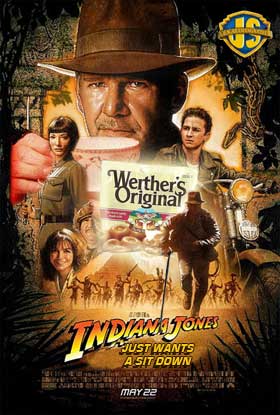
Until the untimely death of Heath ledger, Indy IV was probably the most anticipated film of the year. The release two weeks ago of the well recieved Iron Man has also taken some edge of the release.
But let there be no doubt, this is still a film that the world has been waiting for. And whilst it is thoroughly entertaining, it falls way short of its predecessors, and even some of the more modern variants/imitators/usurpers.
The plot is convolution defined: Indy hooks up with a young kid to first rescue one of Indy’s old colleagues, and the boy’s mother with the suspiciously similar christian name of Marion (… hmmm). This then leads into an adventure to first find a crystal skull, and then return it to its rightful resting place, deep in a secret Incan temple. Throughout all this they are persued by evil Nazis… sorry… Russians who are hell bent on stopping them. They are led by a rather sexy looking Cate Blancett, a psychic who wants to harness the power of the skull for nefarious means.
If this all sounds a little familiar, that’s because that’s EXACTLY what it is. In fact at times, Indy IV resembles little more than a Greatest Hits package of Indy movies past. Some of these references work: the opening twenty minutes take place in a familiar looking warehouse, and is easily the best sequence in the movie, leading to an incredibly tense encounter on a nuclear testing site.
From here, the movie jumps from one action set piece to the next with little regard for logic, and even less regard for letting the audience know what’s going on.
The action is, in the main, well handled. An early motorbike chase is a good showcase for Harrison Ford’s stunt double (though unfortunately this time it’s not the legendary Vic Armstrong, who was otherwise engaged on The Mummy 3), but an over long truck chase is too closely linked to its illustrious Raiders predecessor to be wholly effective. For a start it packs in too many elements, and too many characters in peril, to keep your attention focussed for its duration. Like so many modern action sequences, it flies by in a blur, whereas Indy’s more famous truck chase kept you on the edge of your seat the whole way through.
But the least said about the waterfall the better (it’s even more ridiculous than the waterfall scene in Temple of Doom… see? It’s just doing what was done before, but bigger).
On the subject of action sequences, it’s worth mentioning the modern movies greatest asset, and worst enemy: CGI.
In the build up to the film’s release, Lucas and Spielberg both portrayed themselves as martyrs to the cause of reclaiming movie making from the computers. Spielberg nixed digital film for old fashioned 70mm. The DP studied previous cinematographer Douglas Slocombe’s style to retain continuity, and it was announced that the effects work would be done using traditional methods (matte painting, wires, rear projection) and CGI would only be used where these methods were not possible… I’ll tell you now, that’s utter arse.
CGI gophers? CGI bats? Both used superfluously (with the exception of the hilarious first shot of the movie).
CGI lens flare???? Thirty years ago, lens flare would have been removed from a film. Now they are adding it in!!!!!
In the truck chase, most of the foilage was added in digitally, because it was too dangerous to shoot the chase in such a heavily overgrown area. Fair enough. But don’t then insert CGI foilage for the purposes of cheap gags!
The one exception I can buy, is a large scale giant ant attack, but it’s not very well done.
I’m not adverse to CGI when it’s used well (can you spot the CGI in Casino Royale for instance? And no it’s not the sinking house: that’s a model), it’s just don’t make a big deal about the fact that you’re not using it, and then use it extensively.
One thing the film does have going for it is a superb cast… who are thoroughly wasted. This is Harrison’s show, and no one is going to steal it from him, though Blancett gives it a fair go, hamming it up like Brian Blessed.
Shia LeBeof, playing the same character as Justin Long in Die Hard 4 but in a leather jacket, is enteratining enough. John Hurt gets athankless role as a professor driven nuts by the power of the crystal skull, and Ray Winstone has fun as Indy’s sidekick, no wait he’s a baddie, no, hang on, he’s Indy’s mate again…
Nice to see Karen Allen back in the fold, giving Indy a love interest that’s believable, and her sassyness is very welcome at a time when the film begins to flag a little, but ultimately she’s there to deliver one line and that’s it.
A bright spot is Jim Broadbent as Denholm Elliot’s replacement. Given little to do, he adds a touch of class to proceedings, just like his predecessor (without the comdey buffoon rewrite).
Overall then, it’s a tad disappointing. It’s entertaining enough, with touches of brilliance, but the whole package feels like just that: a package. A demographically approved pick and mix shovelled into an Indiana Jones bag.
Nothing suprises me about Lucas anymore, but from Spielberg you expect more, considering how much affection he and the audience have for the films.
It’s far better than the Star Wars prequels, not as good as any of the original films, and, I fear, come the end of the summer, it may not be the most fondly remembered blockbuster of the year.
Night of the Lepus (1972)
May 6, 2008 5:03 am What is a hungover sunday on a Bank Holiday weekend for except watching trash, eating crap food and generally lounging about in your pants.
That’s generally how I spent the sunday just gone (although I did eventually get dressed), as Lady Scaramanga, myself and Harry Webshiter settled in for a trio of trash cinema at its ‘finest’.
First up is the near-legendary ‘when animals attack’ movie Night of the Lepus. Based on an obscure satirical Australian novel, and subsequently stripped of eveything interesting, this falls into that wonderfully 70s genre. Basically, all these movies (Food of the Gods, Giant Spider Invasion et al), will involve a down-on-their-luck actor battling with poorly matted shots of giant animals, whilst conjuring up a ‘it’s so crazy it just might work’ plan to deal with the situation.
Lepus follows the formula so slavishly that it could be accepted as passable time wasting but for one glaring issue… rabbits are not scary. Yes, that’s right, I said rabbits.
Giant rats are scary. Spiders of nearly any size are scary. Giant mutant sea monsters are scary. Rabbits, of ANY size, are not scary. So the film is crippled from the start.
It’s got an interesting cast. Stuart Whitman and Janet Leigh play a ‘young couple’ (the film’s words, not mine) researching animal behaviour, who are called in by Professor Clark (My GOD! Deforrest Kelly!!!!) to investigate an explosion of the rabbit population in some arse-end-of-nowhere Arizona town.
(This is the sort of town where EVERYONE has a rifle. Surely they’d welcome their lupine friends as target practice and fresh meat?)
Anyhoo… the scientists balls up royally, by using an un-tested serum (Whitman admits having no idea what it does when he administers it), and letting their daughter have a rabbit as a pet. The kid promptly swaps her control rabbit (one that hasn’t been tested on) for another (guess which one…). It gets loose and before you can say chicka-wah-wah it’s shagging every other rabbit in sight, and they start growing to extreme proportions (turns out it was a growth serum… or something).
 Much hilarity ensues as the rabbits march on in slo-mo over Hornby railway models, occassionally stopping to be substituted for a guy in an oversized rabbit costume to attack the townspeople (cue close-ups of cute bunnies with ketchup on their faces).
One quite disturbing scene shows a (dead) rabbit set alight and chucked about (clearly on strings) in the middle of a group of genuine (and presumably terrified) live rabbits.
So, after a failed attempt to trap them in a mine (yeah, rabbits can burrow… you’d think a scientist would know that), it’s eventually decided to electrocute them on a railway line. But not before we’ve had a marvellous sequence where the rabbits attack two pieces of stock footage of cows simultaneously, whilst travelling through time so they are at night, but the cows exist in daytime.
It’s utter tripe, quite frankly. In fairness, some of the effects work is quite good. There’s continuity of scale (a concept many giant animal movies forget, even Jaws was a bit fuzzy on this) and an excellent matte shot of a rabbit approaching a guy hiding behind a truck. But this is undone by the ludicrous ‘man in a suit’ sequences.
The editing is atrocious. Scenes begin and end quite arbitrarily, with post-production dubbing seemingly laid on at random where they feel a scene doesn’t quite make sense. (One scene ended with a piece of dialogue spoken by someone who wasn’t even in the scene).
There is actually very little to recommend Lepus, beyond pure kitsch value. In fact there’s nothing. Except Dr McCoy’s moustache, which you’re sure is going to leap off and attck someone at any minute.
Nowhere near as good as Tarantula or Them; not as joyously exploitative as Food of the Gods; and not even enough to give FOTG 2 a run for its money. It holds curio, after hours entertainment only.


